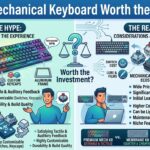
Walk into any gaming setup video, technology forum, or enthusiast workspace and you’ll quickly notice one thing: mechanical keyboards seem to be everywhere.
Fans praise their superior typing experience, durability, and customisation options, while critics argue they’re expensive, noisy, and unnecessary for most users.
So, is a mechanical keyboard genuinely worth the hype, or is it simply another gadget trend?
At Cambridge PC Support, we’re often asked whether upgrading to a mechanical keyboard is worthwhile. The answer depends on how you use your computer, but there are several reasons why so many people make the switch and never look back.
What Is a Mechanical Keyboard?
Unlike a standard membrane keyboard, which uses a rubber dome beneath the keys, a mechanical keyboard uses individual mechanical switches for each key.
Every key has its own dedicated switch mechanism, designed to provide consistent feedback, durability, and accuracy.
This is what creates the distinctive feel and sound that mechanical keyboard enthusiasts love.
Better Typing Experience
The biggest advantage of a mechanical keyboard is simply how it feels to use.
Many people find that mechanical switches provide:
More precise key presses
Better tactile feedback
Greater typing accuracy
A more satisfying typing experience
If you spend hours every day writing emails, creating documents, programming, or gaming, these small improvements can make a noticeable difference.
After switching, many users find ordinary membrane keyboards feel soft or unresponsive by comparison.
They’re Built to Last
Most budget keyboards are designed with cost in mind rather than longevity.
Mechanical keyboards are often built to a much higher standard.
Features commonly include:
Stronger construction
Replaceable keycaps
Higher-quality internal components
Switches rated for tens of millions of key presses
It’s not unusual for a good-quality mechanical keyboard to last many years with proper care.
For users who spend several hours each day at a computer, this can make the higher initial cost easier to justify.
Mechanical Keyboards Aren’t Just for Gamers
Although gaming has helped fuel the popularity of mechanical keyboards, they’re not exclusively for gamers.
Many professionals use them for:
Office work
Programming
Writing
Content creation
Data entry
General productivity
In fact, some people buy their first mechanical keyboard specifically for typing rather than gaming.
Gamers Often Prefer Mechanical Keyboards
For gaming, mechanical keyboards offer several potential advantages.
Many gamers appreciate:
Consistent key actuation
Faster-feeling response
Improved durability during intensive use
Greater customisation options
N-key rollover and anti-ghosting features
Will a mechanical keyboard instantly transform you into an esports champion?
Probably not.
However, many gamers enjoy the more responsive feel, particularly in fast-paced titles where precise inputs are important.
The Different Switch Types
One of the most interesting aspects of mechanical keyboards is that they don’t all feel the same.
Different switch types offer different experiences:
Linear Switches
These provide a smooth key press with no noticeable bump.
Popular among some gamers because they allow rapid key presses.
Tactile Switches
These provide a noticeable bump when the key activates.
Many typists appreciate the feedback because it helps confirm that a key press has registered.
Clicky Switches
These combine tactile feedback with an audible click.
Some users love the classic typing feel, while others find the noise unbearable.
The Biggest Drawback: Noise
Let’s be honest.
Some mechanical keyboards are loud.
Very loud.
While enthusiasts may enjoy the sound, your family, colleagues, or anyone sharing a workspace may not feel the same way.
Fortunately, many modern switches are designed to be significantly quieter than older clicky designs.
If noise is a concern, quieter mechanical options are readily available.
They Can Be Expensive
Mechanical keyboards typically cost more than basic membrane models.
While a standard keyboard might cost £10 to £20, mechanical keyboards can range from around £50 to several hundred pounds.
The question becomes one of value.
For someone who uses a computer all day, every day, investing in a better keyboard can often deliver more noticeable comfort than spending the same amount on a faster processor or extra storage.
Not Everyone Needs One
Despite their popularity, mechanical keyboards aren’t essential.
If you:
Rarely use a desktop computer
Primarily browse the web
Prefer quiet peripherals
Are happy with your current keyboard
then upgrading may not provide enough benefit to justify the cost.
Like many technology purchases, personal preference plays a major role.
What About Wireless Mechanical Keyboards?
Modern wireless mechanical keyboards have improved significantly in recent years.
Many now offer:
Excellent battery life
Low latency
Multi-device connectivity
Compact designs
For home office users, they’re often an excellent compromise between performance and convenience.
Final Thoughts
Mechanical keyboards aren’t merely hype, but they aren’t a necessity either.
For many people, the improved typing feel, better build quality, and long-term durability make them a worthwhile investment. For others, a standard keyboard may continue to meet all their needs perfectly well.
The best keyboard is ultimately the one that’s comfortable for you to use every day.
If you spend hours at your computer working, gaming, or creating content, a mechanical keyboard may be one of the most noticeable upgrades you can make without replacing your entire system.
Looking to upgrade your PC setup? Cambridge PC Support can help with hardware advice, gaming PC upgrades, peripheral recommendations, and troubleshooting to ensure your computer performs exactly the way you want it to.